Our group met at the Haymarket Memorial this morning to begin our walk. I think it was a first for me that a trail head was in a cemetery, but this seemed like a good (and historic) spot to start our ramble upstream along the Des Plaines River.
The Des Plaines, in these parts, is a tired urban river - but it's not the water quality that draws me back again and again. As much as anything it's the history of the waterway that sparks my imagination. The river itself may be unassuming, but its proximity to the Chicago River was the portage, the geographic quirk, that caused Chicago to rise here. French explorers were the first Europeans to discover what the native Americans already knew: there was a link between the Great Lakes and the Mississippi - which by extension linked the Atlantic Ocean and the Gulf of Mexico.
So as we knocked around alongside the river today it made me wonder about all the others who had been here before. There are numerous cemeteries up and down the river, dating back to an era when this was the western edge of the metro area, the open lands at ends of their earth. Of course the river had once been a minor trade route centuries ago, but it also acted as an escape route for those escaping enslavement via the Underground Railroad.
The colors in the woods alongside the river were dull and muted. The brilliant cold and snow of last week had melted, and it is too soon for visible signs of spring/ The spring migration will soon bring colorful birds back from southern lands. Today we enjoyed the company of sparrows and winter juncos, not quite yet displaced from their perches.
Humans also come and go. As we took a shortcut through a second cemetery the surnames on the old tombstones turned 19th century and German. Our group was small, but it wasn't lost on me that our hikers hailed from all over the world. We, like millions before us, came to this corner of the planet, hoping to create decent lives in this metropolis borne of a swampy river portage. And today, we left our own footprints in the muddy trails along the Des Plaines.
Showing posts with label urban nature. Show all posts
Sunday, February 21, 2016
Thursday, January 21, 2016
Landscape history lessons....at the car wash.
I suspect there are quite a few people who, when they learn of my occupation, imagine that I am spending my days in forests and meadows, surrounded by the glories of nature. Yes, I sometimes do have those moments, but the majority of my time is spent working in locales that are far more familiar to any of us who lives in urbanized places. During this past week my travels brought me to possibly one of the most unlikely places I’d expect to get a lesson in landscape history: a car wash.
I was asked to do perform a tree inventory for the parcel of land the car wash occupied. The lot was surrounded by very busy, high volume roadways. The purpose of the inventory was to help assess the existing conditions there - a part of the permitting process. When I arrived on the site I expected a run-of-the-mill survey of species that one encounters all the time in such built up places. And while it was true the car wash trees were types that were (mostly) common this particular assemblage provided a remarkable miniature study of local urban forestry issues that any tree geek would appreciate.
There are times when one can divine a landscape’s history by looking at what is growing there. The car wash landscape - I’m guessing - was planted in the 1970’s or 80’s. The older trees were all in the 10-20 inch diameter range, and like species were all pretty much the same size, which likely equates to age in this case.
There was a group of leggy Austrian pines growing too close together, planted too near the neighbor’s building that had all been limbed up out of necessity. When they went in they were probably cute, but they were thin now, their crowns stunted. On the other side of the lot were a line of Green ash trees that were all in the 14-17 inch diameter range. They were all decimated by Emerald ah borer, and the only living thing on them now were suckers - slender branches that the tree shoots out in a final desperate attempt to survive. One could see that, in their day, these had made up a really nice row of trees.
There were other normally reliable species such as crabapples, hackberries, and maples that were in various stages of decline. One could see the usual signs of a tired landscape: insect infestation, poor management (pruning, etc). It is a car wash, after all, not a public garden. Of the planted trees, the handful of hackberries seemed the most durable, but even they had witches brooms - signs of distress that I’m guessing may been a symptom of air pollution and/or salt spray damage.
Of all the trees on the site the ones that seemed the most vigorous were the handful of White poplar trees. This is a species that is normally seen as invasive and even somewhat weedy. Nurseries don’t grow them. The poplars that grew here actually were pretty happy in this otherwise harsh setting - along roadways that, according to IDOT, carry over 60,000 cars per day. Perhaps these are the urban trees of the future?
Possibly the most interesting find for me was the sight of a battered, nearly dead, Russian olive tree hidden in a neglected corner of the lot, on the edge of drainage ditch. Russian olives are a species that was once promoted as one that would attract wildlife. They could still be seen around Chicago pretty regularly in the 1980’s, but even then they were fading fast. Another introduction that was a bad idea, they either became invasive in places, or unreliable in others (i.e. Chicago). I see them now rarely, maybe once a year.
This car wash - of all places - would be a great field visit stop for my plant ID students. It’s all here on display: good and bad planting choices; invasive plant and insect species; all knitted together on a landscape that is likely going to be wiped clean and started anew. It’s good to remember that these trees, when installed decades ago, would have been seen as a pretty solid and durable choices. It will be interesting to see what the future holds for this otherwise anonymous landscape.
Friday, January 15, 2016
A Winter's Ramble....
One thing that social media can do is bring together those who can share mutual interests. And so it was last weekend when five otherwise bright people defied the winter cold - even by Chicago standards - for a January hike along Lake Michigan.
Our merry band kicked off what will hopefully be monthly excursions to explore the natural world that sometimes seems hidden in our urbanized world. I thought that our leaders made a splendid choice for an inaugural trek, as the dramatic Lake Michigan shoreline is anything but hidden from a visual standpoint. We met at midday at the north end of Lake Shore Drive and headed south.
Cold cold cold cold cold. So we shoved off - moving briskly. There seemed to be general agreement that the bright sunshine and the wind at our backs made for an overall lovely day. One flock of gulls were tucked into snow covered sand - which was an odd sight that I had never seen before. The scene also included about ten pigeons who were foraging over the sand demonstrating that we were at least as clever and hardy as these avian neighbors.
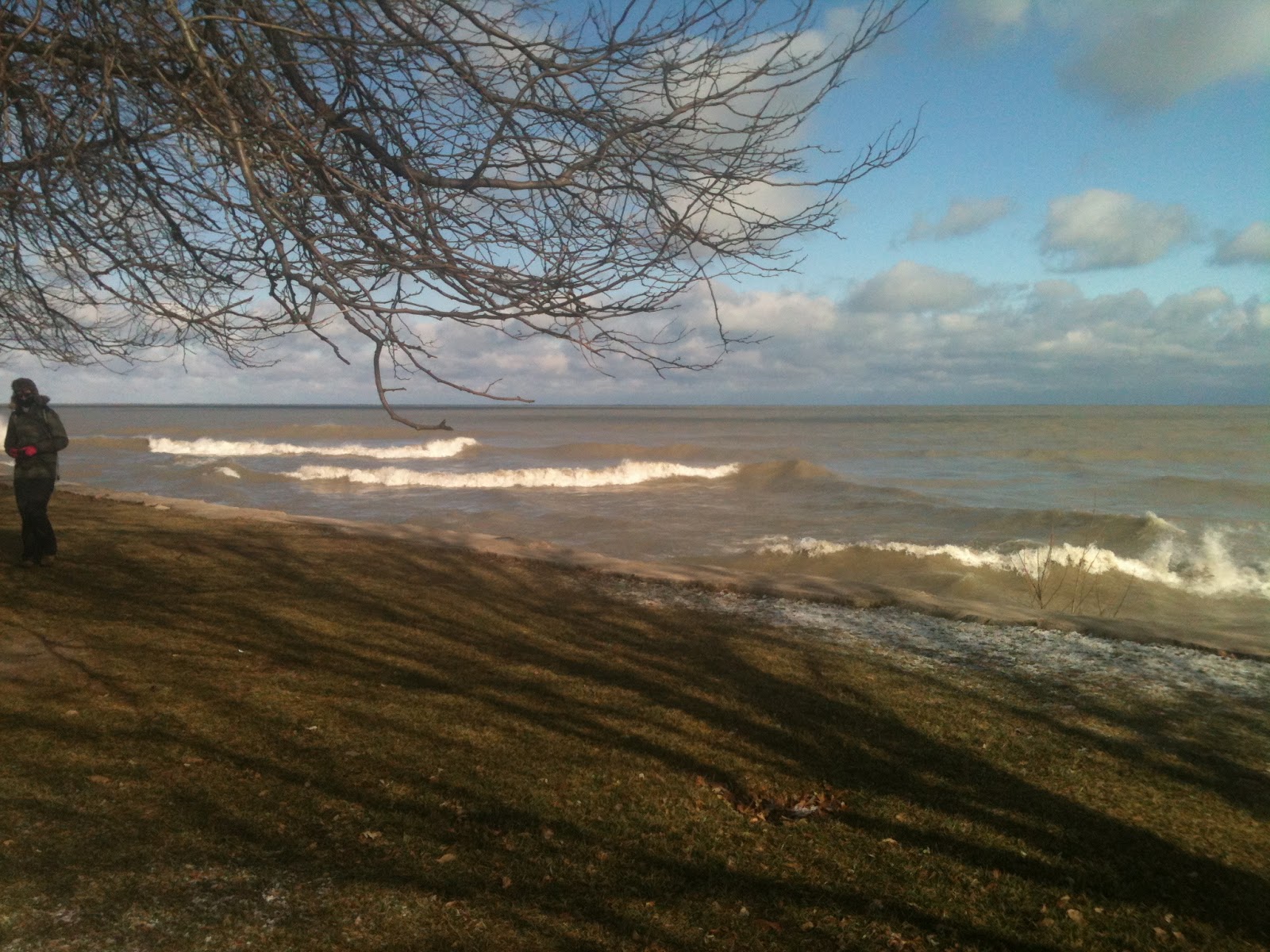
The lake itself was choppy, and when we walked further south waves the color of weak cocoa were breaking over the concrete seawalls. Spindly plants that grew out of the fissures in the concrete were covered in new ice. We followed the path south, and soon we were upon Montrose Harbor where there were quite a few dogs (and their humans) cavorting on the dog beach. We trundled through the dune lands around the Magic Hedge, and as we made our way around the harbor we spotted Buffleheads and Mergansers sharing the waters with the Canada Geese.
Our merry band kicked off what will hopefully be monthly excursions to explore the natural world that sometimes seems hidden in our urbanized world. I thought that our leaders made a splendid choice for an inaugural trek, as the dramatic Lake Michigan shoreline is anything but hidden from a visual standpoint. We met at midday at the north end of Lake Shore Drive and headed south.
Totem pole :: Chicago (2016)
Cold cold cold cold cold. So we shoved off - moving briskly. There seemed to be general agreement that the bright sunshine and the wind at our backs made for an overall lovely day. One flock of gulls were tucked into snow covered sand - which was an odd sight that I had never seen before. The scene also included about ten pigeons who were foraging over the sand demonstrating that we were at least as clever and hardy as these avian neighbors.
Sun, surf, sand, snow, seagulls :: Chicago (2016)
Chicago (2016)
The shoreline gradually swept away and the skyline of the city came into full view. There were times when I felt like we were exploring an alien world, but soon we would pass by various sculptures, giving us clues as to makeup of the civilization buzzing across the Outer Drive.
Amidst frozen ripples :: Chicago (2016)
***
Urban nature, art, and great conversation w/ @Foot_and_Ink today! Photos: https://t.co/MUjCYgHHv7 pic.twitter.com/5PByrlfupM
— Jamie McCarthy (@jamersmcc) January 11, 2016
Urban wildlife encounters on #LakesideTrail today: goldeneyes, red-tailed hawk, robin with berry, and dinosaur. pic.twitter.com/JzK4ek5aOQ
— UrbanNatureWalks (@Foot_and_Ink) January 11, 2016
Wednesday, December 30, 2015
When life gives you sleet.....
Some people build snowmen, but I took a little break from chopping through layers of frozen sleet to build the only inukshuk on the block - to add to our holiday displays:
Cook County, IL :: 2015
Monday, December 28, 2015
Mark Your Calendars
Be there! 1/15-17 > 7th Ann'l MLK Food Justice & Sustainability Weekend. 2016 theme Climate Change and Native Food. pic.twitter.com/oO51TgJc5A
— Dave Coulter (@Dav_Coulter) December 28, 2015
Monday, December 21, 2015
Wednesday, November 18, 2015
Living on the (H)edge
Labels:
biodiversity,
birds,
hedgerows,
history,
trees,
urban nature,
writing
Wednesday, September 30, 2015
My Conflicted Harvest
I.
It’s a hell of a thing when we live in a world where we have
to erect fences to keep the vegetables safe from....I'm not sure who.This was among
my initial thoughts as I pulled up to the urban garden that had been built on
the site that used to be occupied by the Robert Taylor Homes. I toured the site
along with my grad school classmates, and I’d been looking forward to the visit
as I’ve also occasionally taught a lot of the concepts of urban gardening to my
students. The reasons that many (myself
included, from time to time) have advocated for urban farming – gardening,
really – are numerous. You have possibly heard of many of them. They’ll
include:
- City people (especially the little kids) don’t know where their food comes from, and this is wrong.…
- There’s going to be something like 9 billion people on Earth by 2050, and we’ll need more food to feed them. Urban gardens will help feed them..
- Many people have crappy diets, and they eat a lot of junk food. The concerns are that this will lead these folks to serious health problems in their future. “Urban” gardens will also help to mitigate this issue. (I’m left wondering what sort of gardens will develop in rural areas – where the diets are often equally crappy, yet land for growing veggies is all over the place)….
- We need to develop local food networks in order reduce the need and costs associated with shipping food all over the place – and to facilitate the previous points. I guess there is some logic to this, as cities are certainly where all the people are….
- Urban gardens – as a practice – will foster a new generation of urban farm businesses that will grow food that people want. They will also provide jobs to people in areas where employment options are often very thin….
- Because there are these things called food deserts in the poorer parts of our cities. (Again, I’m left wondering what sort of food options will develop in rural areas – where grocery stores are often spread out across vast distances too. At least there is lots of vacant land if someone wants to build one)….
- Oh, and, many of these above listed goals must be sustainable over the long haul….
- Lastly, and most importantly, (in my mind anyway) is that urban gardens have the potential to get food into the hands of low income people that could really use it….
I’d arrived with a hopeful and positive outlook on what I
was going to see and learn, but when I drove away my thoughts were far
more mixed.
II.
The gardens we toured are managed by the Chicago Botanic
Gardens, as part of their Windy City Harvest program. This particular site – it should be pointed
out – is not open to just anyone who walks in.
The raised bed gardens are tended by those who have completed their
training program first. Afterwards, these graduates are then allocated space to
grow crops for a two year period. Many
use this facility as a sort of business incubator, providing food and floral
crops for farmers markets and the like. I pray that I’m wrong, but my sense was
that the people tending the beds that day were from everywhere but the adjacent
neighborhoods.
This property was once the site of the Robert Taylor Homes,
and is now, according to our hosts, leased for 100 years by a developer. These gardens were safe for anther few years, but the issue of property ownership is one of the
uncomfortable realities of many community gardens. They'll often exist only as
long as there is a benevolent land owner that lets them scratch around the soil until they can sort out what to do with the site.
The way these gardens were constructed was a model of
impermanence. All the planting beds were
raised, built over the existing grade – the remnants of demolished housing
towers. The hoop houses, the requisite compost
bins, and tool shed could all be dismantled, hauled off, or bulldozed in a day
by a competent contractor. The garden
operation will be sustainable until someone wants build a shopping center,or townhouses, and
then that will be that. One can only hope the development will have a grocery store where people can buy some food.
III.
On of the admirable goals of this operation was the plan to
deliver crops to those in the city who get assistance to buy food. Residents could obtain vouchers to exchange
for produce sold at local farmers markets. We were told that, unfortunately,
this program was under-utilized for what sounded like a number of bureaucratic
structural reasons. Also, it seemed that simply getting to a farmers market
isn’t as easy as one might hope. Inspired,
I asked why people couldn’t simply exchange vouchers for produce directly from that facility. I later realized that much of what was grown
there was said to be delivered and sold at farmers markets in tonier locales such
as Hyde Park, Rogers Park, and so on.
During the course of our visit there was an implication that
there was tension between the gardens and the neighbors. Hard to imagine why
there would be resentment when a bunch of high minded outsiders come into town
and get to garden in lovely plots (built for them for free) all of it protected
by a substantial chain link fence. During the tour, I picked up that one of the garden
businesses was named “garden anarchy” – or such like. Yeah! Stick it to the
man! How easy it is to proclaim anarchism (over craft beer, I’m betting) when
the whole shebang is subsidized by the largesse of a developer and wealthy donors.
Heaven forbid that a real anarchist should take a pair of bolt cutters to that fence.
IV.
Okay, so maybe it’s me who has the problem. And, okay, maybe all of our goals (see Part
I) aren’t exactly being met – but isn’t that still better than doing
nothing? How can I complain about a
garden rising from the ashes of a failed housing project? Aren't the people working there trying to make a difference? Am I a
little jealous that I’m not a self-proclaimed garden anarchist?
I recall once reading about how urban gardens facilitate gentrification. When I’ve mentioned this to colleagues I’ve gotten either
hostile or muddled responses. However,
when I see stories like this – this connection may not be all that imaginary. I
can understand why local residents might view the sight of hipsters tending beds of kale as a
harbinger of hard times ahead.
Taking all of these things together, I’m just not sure what
the purpose of these urban gardens is. I don’t think they are the most effective long
term solution to the very real problems of food and hunger in the world. Perhaps they are best at getting people
out, in the sun, and talking to one another. During our tour, everyone seemed
happy to be there. The summer vegetables were fat and gleaming. Freshly
harvested carrots, too stunted for sale, were washed and shared among the
visitors. A Red-tailed hawk, swooped and perched for his audience on a nearby
power pole. On such a lovely day, inside the fence, the optimism was real, and
the gardens were lovely.
Sunday, August 02, 2015
Wednesday, July 22, 2015
The secret of the seal, under the trees...
One of the reasons that I love the work I do is that the natural world offers an unending capacity for surprise. Even in this corner of the world that is seemingly more pavement than greenery there are remarkable organisms - hanging on by a thread. On a job site I recently came across a plant I had never seen in the field before: Golden Seal.
Golden Seal (Hydrastis canadensis)
I guess I shouldn't be surprised that I have not seen this before, as it has apparently been over-harvested for it's purported value in folk medicine. This little stand of plants was growing quite happily on private land - where there is an owner that is committed to restoring this area and removing invasive species.
Locally, the Plants of Concern project has Golden Seal listed on it's roster of plants that are being monitored. One of the keys to future preservation of such plants is secrecy. It's not far-fetched to imagine that if this plant were on public land it would be gone by now. As it is today, on private property, under the care of a concerned homeowner - these plants have a fighting chance.
It's worth noting also that these plants were seen in an area that had a fair number of invasive plants in their vicinity. At the first glance, it was a landscape that wouldn't normally appear to hold such surprises. As always, tread carefully and keep those eyes open!
Labels:
endangered species,
urban nature,
wildflowers
Friday, July 10, 2015
Hedgerow gap...
Just putting the finishing touches on a new paper about hedgerows and birds....
Cook County, IL :: June, 2015
Labels:
hedgerows,
rural nature,
urban nature,
writing
Scenes from Indiana Dunes
Here's some shots from last week's visit to Indiana Dunes National Lakeshore:
Dawn near Chellberg Farm
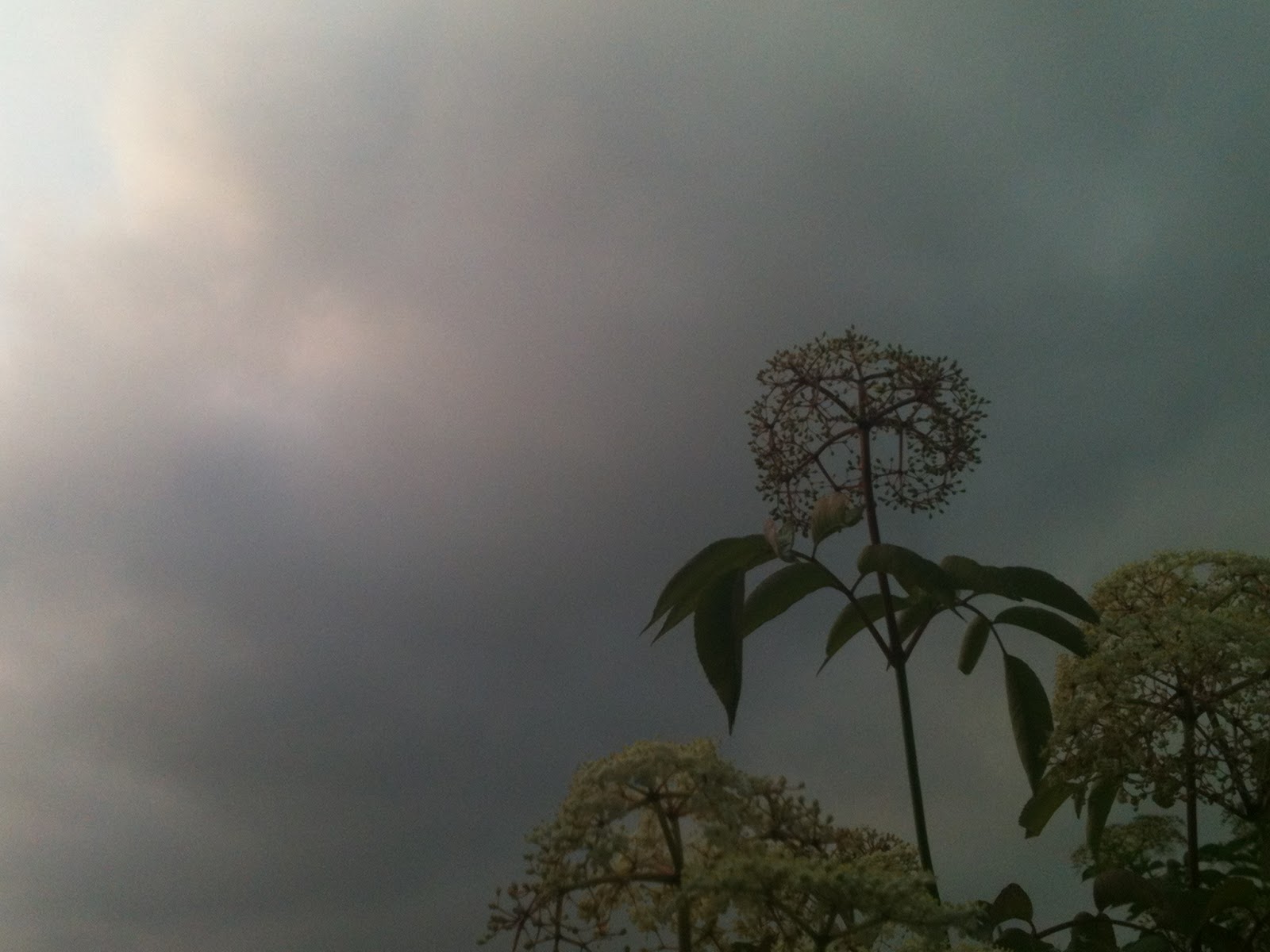
Elderberries and rain clouds...
Sundew at Pinhook Bog
Royal fern at Pinhook Bog
Lunch on the trail : )
Grass Pink orchid
West Beach
Hairy Puccoon
As seen in the field....Pollinators in the city...
Right across a busy road: a native perennial flower (purple coneflower) that drew in a native pollinator (Red Admiral). It can be done - even in a city!
Friday, March 27, 2015
Life in the Margins: The Role of the Post-Modern Hedgerow
Late last month a new essay of mine appeared in Solutions Journal. It is titled Life in the Margins: The Role of the Post-Modern Hedgerow, and I hope you enjoy it!
Remnant hedgerow, Du Page County, IL.
Labels:
biodiversity,
hedgerows,
rural nature,
urban nature,
writing
Subscribe to:
Comments (Atom)