Our group met at the Haymarket Memorial this morning to begin our walk. I think it was a first for me that a trail head was in a cemetery, but this seemed like a good (and historic) spot to start our ramble upstream along the Des Plaines River.
The Des Plaines, in these parts, is a tired urban river - but it's not the water quality that draws me back again and again. As much as anything it's the history of the waterway that sparks my imagination. The river itself may be unassuming, but its proximity to the Chicago River was the portage, the geographic quirk, that caused Chicago to rise here. French explorers were the first Europeans to discover what the native Americans already knew: there was a link between the Great Lakes and the Mississippi - which by extension linked the Atlantic Ocean and the Gulf of Mexico.
So as we knocked around alongside the river today it made me wonder about all the others who had been here before. There are numerous cemeteries up and down the river, dating back to an era when this was the western edge of the metro area, the open lands at ends of their earth. Of course the river had once been a minor trade route centuries ago, but it also acted as an escape route for those escaping enslavement via the Underground Railroad.
The colors in the woods alongside the river were dull and muted. The brilliant cold and snow of last week had melted, and it is too soon for visible signs of spring/ The spring migration will soon bring colorful birds back from southern lands. Today we enjoyed the company of sparrows and winter juncos, not quite yet displaced from their perches.
Humans also come and go. As we took a shortcut through a second cemetery the surnames on the old tombstones turned 19th century and German. Our group was small, but it wasn't lost on me that our hikers hailed from all over the world. We, like millions before us, came to this corner of the planet, hoping to create decent lives in this metropolis borne of a swampy river portage. And today, we left our own footprints in the muddy trails along the Des Plaines.
Showing posts with label birds. Show all posts
Sunday, February 21, 2016
Friday, January 15, 2016
A Winter's Ramble....
One thing that social media can do is bring together those who can share mutual interests. And so it was last weekend when five otherwise bright people defied the winter cold - even by Chicago standards - for a January hike along Lake Michigan.
Our merry band kicked off what will hopefully be monthly excursions to explore the natural world that sometimes seems hidden in our urbanized world. I thought that our leaders made a splendid choice for an inaugural trek, as the dramatic Lake Michigan shoreline is anything but hidden from a visual standpoint. We met at midday at the north end of Lake Shore Drive and headed south.
Cold cold cold cold cold. So we shoved off - moving briskly. There seemed to be general agreement that the bright sunshine and the wind at our backs made for an overall lovely day. One flock of gulls were tucked into snow covered sand - which was an odd sight that I had never seen before. The scene also included about ten pigeons who were foraging over the sand demonstrating that we were at least as clever and hardy as these avian neighbors.
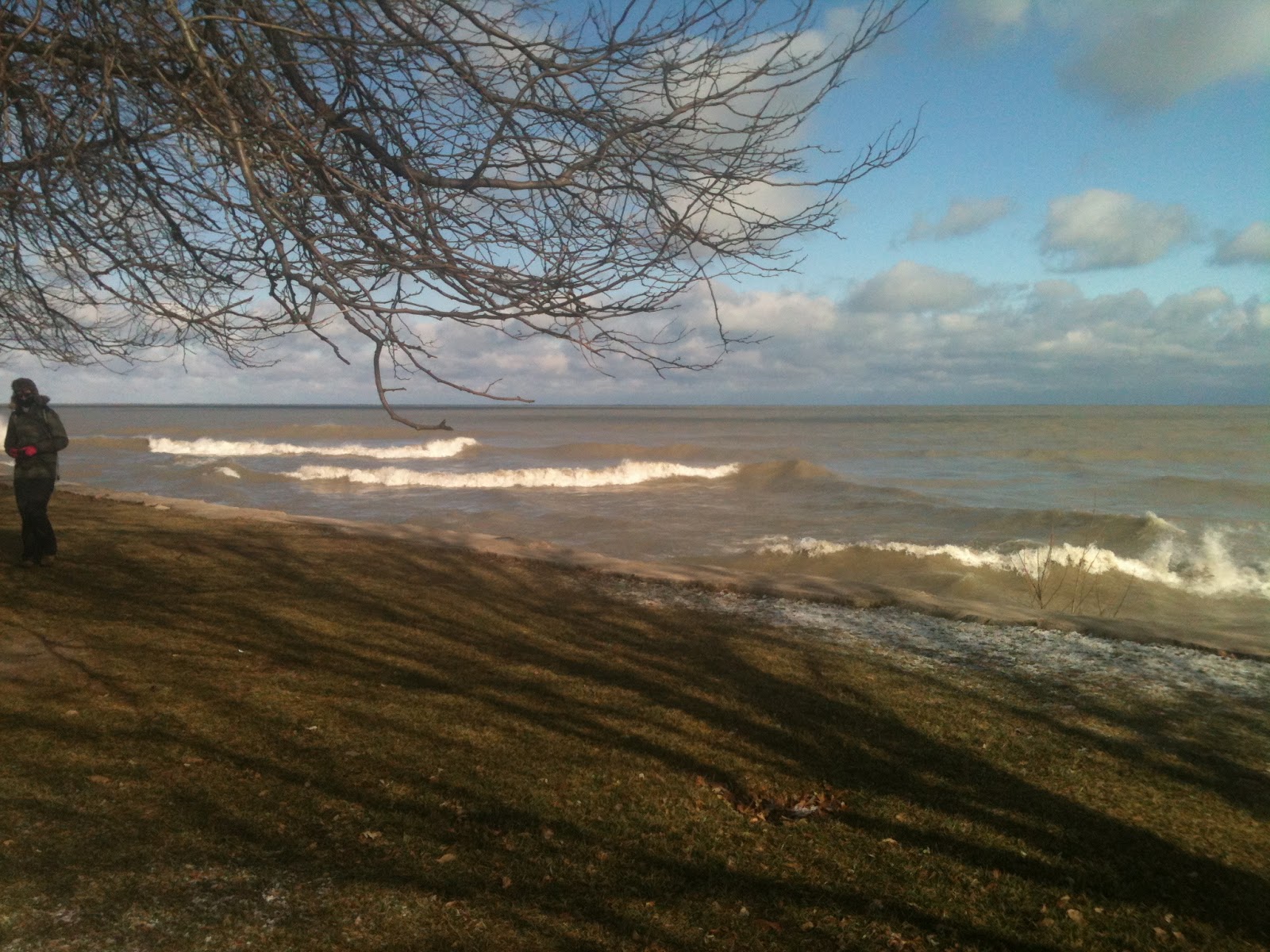
The lake itself was choppy, and when we walked further south waves the color of weak cocoa were breaking over the concrete seawalls. Spindly plants that grew out of the fissures in the concrete were covered in new ice. We followed the path south, and soon we were upon Montrose Harbor where there were quite a few dogs (and their humans) cavorting on the dog beach. We trundled through the dune lands around the Magic Hedge, and as we made our way around the harbor we spotted Buffleheads and Mergansers sharing the waters with the Canada Geese.
Our merry band kicked off what will hopefully be monthly excursions to explore the natural world that sometimes seems hidden in our urbanized world. I thought that our leaders made a splendid choice for an inaugural trek, as the dramatic Lake Michigan shoreline is anything but hidden from a visual standpoint. We met at midday at the north end of Lake Shore Drive and headed south.
Totem pole :: Chicago (2016)
Cold cold cold cold cold. So we shoved off - moving briskly. There seemed to be general agreement that the bright sunshine and the wind at our backs made for an overall lovely day. One flock of gulls were tucked into snow covered sand - which was an odd sight that I had never seen before. The scene also included about ten pigeons who were foraging over the sand demonstrating that we were at least as clever and hardy as these avian neighbors.
Sun, surf, sand, snow, seagulls :: Chicago (2016)
Chicago (2016)
The shoreline gradually swept away and the skyline of the city came into full view. There were times when I felt like we were exploring an alien world, but soon we would pass by various sculptures, giving us clues as to makeup of the civilization buzzing across the Outer Drive.
Amidst frozen ripples :: Chicago (2016)
***
Urban nature, art, and great conversation w/ @Foot_and_Ink today! Photos: https://t.co/MUjCYgHHv7 pic.twitter.com/5PByrlfupM
— Jamie McCarthy (@jamersmcc) January 11, 2016
Urban wildlife encounters on #LakesideTrail today: goldeneyes, red-tailed hawk, robin with berry, and dinosaur. pic.twitter.com/JzK4ek5aOQ
— UrbanNatureWalks (@Foot_and_Ink) January 11, 2016
Wednesday, November 18, 2015
Living on the (H)edge
Labels:
biodiversity,
birds,
hedgerows,
history,
trees,
urban nature,
writing
Tuesday, July 14, 2015
Thanks, Mister Hess...
Over the course of the past month I have been monitoring birds in and around two roadside hedgerows in Cook County. I was doing this for my most recent master's course, but going out and counting birds in your neighborhood is a pursuit that I would recommend to anyone. These ideas seem to start out simply enough, but before you know it counting birds in old hedgerows may lead to some interesting places.
As I was tracking down articles about such topics, I came across an article from over 100 years ago that intrigued me. In 1910, Isaac Hess wrote an article that appeared in The Auk, titled "One Hundred Breeding Birds of an Illinois Ten-Mile Radius." Hess was from the town of Philo,Illinois - in Champaign, County. Hess was a merchant by trade, but a naturalist at heart. In this article, Hess summarized some 12 years worth of remarkable field observations taken within the confined radius of his homestead.
For my purposes, I was initially seeking out local references about birds and hedgerows - but ultimately, I was captivated by this glimpse of a landscape from a century ago. I loved reading Hess' writing - a style that was clear and uncomplicated. His local landmarks were groves of trees and local watercourses - geographical thinking that is virtually extinct in this Age of Mapquest. I have to wonder what, if anything, remains of these wooded parcels that he'd named.
27. Antrostomus vodiferus. WHIP-POOR-WILL.- Common summer resident. Arrives April 25 to May 1. Found only in the upland woods after their arrival from the south. Here they stay but a few days, leaving for the low damp woods for nesting. I have succeeded in finding but one set of eggs. This was a set of two taken May 16, 1901. A great deal has been written about this bird's night notes and the number of times they are repeated. At midnight on a moon-light night in May, 1905, I counted 175 repetitions of "whip-poor-will" before a pause was taken.
No one writes (in scientific journals, certainly) about Whip-poor-wills calling in the moonlight any more. Hess wrote in a language of a different time that describes a bird that - one hundred years later - seems to be declining in numbers. Anyway, thanks, Mr. Hess, for committing to paper and ink years worth of field work that shows us modern folk what once was. If you were here today, you'd see that a great deal has changed. Nevertheless, some of us are still out there poking around the field margins, following in those large footsteps of yours.
Labels:
birds,
hedgerows,
history,
rural nature,
writing
Subscribe to:
Comments (Atom)